I have a... weird cockpit drain system. It consists of a bronze thru-hull secured to the hull with a single bronze nut, then has a bronze coupler threaded onto the thru-hull then a bronze adapter is threaded into the coupler THEN a ball valve is threaded onto that adapter. To top off everything, a plastic tail piece is threaded onto the ball valve. The whole thing is a foot tall or so. Believe it or not, it works and has for 29 years or so.
I have sailed with this set up for several years. I didn't replace it right away because I didn't know any better (until now, that is). It works fine but it is beginning to creep me out so I have to replace it before the boat goes into the water.
The boat is a Sea Sprite 23 and even though it is a classical CCA style sailboat, its not heavily built. The fiberglass around the thru hull area is only 1/4" or so thick. So obviously a nice 1/2" thick fiberglass backing plate is a must have. Otherwise, the bolts of the seacock has almost nothing to grip on.
Therin lies my question. I have looked in McMaster-Carr and I am OVERWHELMED by the sheer variety of flat fiberglass plates. Could anyone be kind enough and tell me which type of fiberglass sheet is best for my purposes?
- Case
Fiberglass Backing Plate
-
catamount

- Candidate for Boat-Obsession Medal
- Posts: 378
- Joined: Sun Jun 19, 2005 7:30 am
- Boat Name: GREYHAWK
- Boat Type: Peterson 34
- Location: Boothbay Harbor, ME
- Contact:
Look under Plastics by material type for "'Grade G-10 Garolite" (rather than "Fiberglass").
A 12" x 12" sheet of 1/2" G-10 is Part Number 9910T41. It is not inexpensive, but I was able to cut quite a few seacock backing plates out of one:
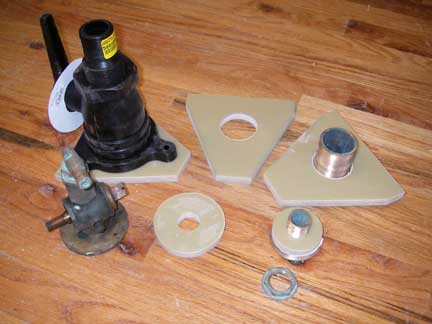
A 12" x 12" sheet of 1/2" G-10 is Part Number 9910T41. It is not inexpensive, but I was able to cut quite a few seacock backing plates out of one:
Last edited by catamount on Thu Apr 30, 2009 7:21 pm, edited 1 time in total.
Tim Allen -- 1980 Peterson 34 GREYHAWK
Harborfields Housekeeping Cottages, West Boothbay Harbor, Maine
Sailors for the Sea, a new voice for ocean conservation
Harborfields Housekeeping Cottages, West Boothbay Harbor, Maine
Sailors for the Sea, a new voice for ocean conservation
-
Tim

- Shipwright Extraordinaire
- Posts: 5708
- Joined: Tue Apr 01, 2003 6:39 pm
- Boat Name: Glissando
- Boat Type: Pearson Triton
- Location: Whitefield, ME
- Contact:
There is a huge variety of fiberglass and related products available; most of them are designed for very specific uses, such as chemical resistance, electrical properties, and other characteristics. Therefore, most of the choices can be immediately discounted for our purposes.
In my opinion, there are two basic options that one might consider for use as backing plates:
Standard Polyester Fiberglass Panel
I normally choose polyester fiberglass sheet--an extremely strong, dense, and heavy material that works very well for backing plates. This is the greenish material that I have frequently used. There are many thicknesses, but normally one might choose 1/4" or 1/2".
A 12"x12" sheet of 1/2" FRP is McMaster part #8537K26 (link) ($28.24). This page number may change in the future, but the part number should remain constant.
Grade G-10 Garolite
G-10 Garolite is a product made using fiberglass cloth and epoxy resin. Plain G-10 is a good choice for backing plates as well and is somewhat stronger than the polyester FRP panel. (The similar grade G-10/FR4 is a flame-retartant version of G-10.) The price of G-10 is double that of the polyester sheet, and I question whether there's any true reason to use G-10 for this sort of application.
A 12"x12" sheet of 1/2" G-10 is McMaster part # 9910T41 (link) ($56.04) This page number may change in the future, but the part number should remain constant.
For the sake of comparison, here is a small chart showing the relative tensile strength of G-10, polyester fiberglass, and other materials. Of course, the ultimate tensile strength of either product would never be put to the test as a backing plate. Either material makes great backing plates--non-compressive and water resistant.
---------------------------------------------------
Forum Founder--No Longer Participating
Forum Founder--No Longer Participating
-
Quetzalsailor
- Master of the Arcane
- Posts: 1100
- Joined: Fri Aug 26, 2005 9:53 am
- Boat Name: Quetzal
- Boat Type: LeComte North East 38
- Location: Philadelphia, PA
-
Ceasar Choppy

- Boat Obsession Medal Finalist
- Posts: 622
- Joined: Thu Mar 09, 2006 11:05 am
- Location: Port Starboard, MD
For big backingplates for thru-hulls and seacocks, I agree that the regular FRP works good. I've also used coosa board (fairly lightweight stuff) that I epoxied with glass onto the inside of the hull for thickness.
Backingplates for hardware, on the otherhand I think require something stronger like the G-10. I'm actually partial to the Electrical grade FRP (the red stuff) because it is cheaper than the G-10 with similar tensile strength and it is very dense. The biggest problem with using regular FRP for backingplates is the tendency to deform under high load (i.e. you tighten down the bolts for that cleat hard and the nuts and washers sink into the FRP and deform it).
Backingplates for hardware, on the otherhand I think require something stronger like the G-10. I'm actually partial to the Electrical grade FRP (the red stuff) because it is cheaper than the G-10 with similar tensile strength and it is very dense. The biggest problem with using regular FRP for backingplates is the tendency to deform under high load (i.e. you tighten down the bolts for that cleat hard and the nuts and washers sink into the FRP and deform it).
-
MikeD
- Candidate for Boat-Obsession Medal
- Posts: 375
- Joined: Wed Aug 24, 2005 1:42 pm
- Boat Name: Totoro
- Boat Type: Sea Sprite 23 (#626)
- Location: Scarborough, Maine
I must be missing something. From Tim's chart, it looks like FRP would be the material of choice, unless the "density" is an entirely different property than the "tensile strength"...
Mike
Totoro (SS23 #626)
Totoro (SS23 #626)

Great timing on this thread for me - I'm just choosing what to use for backing plates for some seacock installations. I was pretty set on some form of FRP board from McMaster until someone brought up that the [slight] flexibility of plywood backers might be an advantage (in not creating stress risers).
I have a feeling it might be a horse apiece, but, on the other hand, I have th choice to make, so might as well make the right one even if there isn't a huge difference. I think I'm going to affix the backing plate to the hull and then either tap-and-machine-screw (FRP) or lag (wood) the seacocks to them.
Mike, I see why you're confused; I also don't see why even the "plain" FRP board would deform when tightening, since it's stronger than bronze by quite a bit. I mean, not that bronze is that strong, but it doesn't just cave in when you tighten up a washer against it either.
On another note: Eeek, have seacocks gotten expensive. I suppose it's the copper content (?)
Rachel
-
bcooke
- Master of the Arcane
- Posts: 2272
- Joined: Sat Oct 04, 2003 10:55 pm
- Boat Name: Jenny
- Boat Type: 1966 Pearson Triton
- Location: Rowley, MA
- Contact:
Yep. There goes another $500-$1000...On another note: Eeek, have seacocks gotten expensive?
Maybe I am lulled by my 3/4" thick hull which probably doesn't even need any back up but is strength such a huge issue with backing plates?
Fiberglass is clearly superior but I have been using up some 3/4" marine okoume plywood soaked in epoxy that I have felt is strong enough for its intended application.
-Britton
-
Ceasar Choppy
- Boat Obsession Medal Finalist
- Posts: 622
- Joined: Thu Mar 09, 2006 11:05 am
- Location: Port Starboard, MD
It is. I mistated. Density and compressive strength is what you are after I think for backing plates. Tensile strength is only the ability (or not) of the material to be torn or ripped apart.MikeD wrote:I must be missing something. From Tim's chart, it looks like FRP would be the material of choice, unless the "density" is an entirely different property than the "tensile strength"...
-
catamount
- Candidate for Boat-Obsession Medal
- Posts: 378
- Joined: Sun Jun 19, 2005 7:30 am
- Boat Name: GREYHAWK
- Boat Type: Peterson 34
- Location: Boothbay Harbor, ME
- Contact:
This is why I went with the G-10 for my seacock backing plates, 'cause I'm going to tap them for machine screws to secure my seacocks (which, in my case, are Marelon rather than bronze).Rachel wrote: I think I'm going to affix the backing plate to the hull and then either tap-and-machine-screw (FRP) or lag (wood) the seacocks to them
Tim Allen -- 1980 Peterson 34 GREYHAWK
Harborfields Housekeeping Cottages, West Boothbay Harbor, Maine
Sailors for the Sea, a new voice for ocean conservation
Harborfields Housekeeping Cottages, West Boothbay Harbor, Maine
Sailors for the Sea, a new voice for ocean conservation
-
bcooke
- Master of the Arcane
- Posts: 2272
- Joined: Sat Oct 04, 2003 10:55 pm
- Boat Name: Jenny
- Boat Type: 1966 Pearson Triton
- Location: Rowley, MA
- Contact:
Just for another installation idea,
Why drill and tap the backing plates when you could just drill completely through the hull and bolt the seacock to the hull, sandwiching the backing plate in between (which could still be 'glued' to the hull permanently)? Or are we talking a thin skinned boat that can't support countersunk bolts through the hull?
-Britton
-
Ancient Race
- Almost a Finish Carpenter
- Posts: 94
- Joined: Wed Aug 30, 2006 9:41 pm
- Location: Cleveland
I'm addressing this problem myself this Spring - if the weather ever stabilizes here enough to un-tarp the boat. My old Tartan certainly has the hull thickness. But from my perspective, extraneous holes in the boat are to be avoided.bcooke wrote:Just for another installation idea,
Why drill and tap the backing plates when you could just drill completely through the hull and bolt the seacock to the hull, sandwiching the backing plate in between (which could still be 'glued' to the hull permanently)? Or are we talking a thin skinned boat that can't support countersunk bolts through the hull?
-Britton
Given that I'm not heading offshore, the additional strength gained by drilling through the hull over tapping into a 1/2" G-10 block just doesn't seem warranted. Your mileage - and circumstances - no doubt vary.
Tartan 27 #77
Seafarer Meridian 26
Jet 14 #952
Seafarer Meridian 26
Jet 14 #952
-
Figment
- Damned Because It's All Connected
- Posts: 2847
- Joined: Tue Apr 08, 2003 9:32 am
- Boat Name: Triton
- Boat Type: Grand Banks 42
- Location: L.I. Sound
To my mind, much of the purpose of a backing plate on a thru-hull is that it gives the seacock something flat to settle against. Strength has little to do with it.
Tapping into a backing plate is an interesting idea, but by the time you're done with the pilot tap and then the bottoming tap, through bolting might just be less hassle.
Tapping into a backing plate is an interesting idea, but by the time you're done with the pilot tap and then the bottoming tap, through bolting might just be less hassle.
-
catamount
- Candidate for Boat-Obsession Medal
- Posts: 378
- Joined: Sun Jun 19, 2005 7:30 am
- Boat Name: GREYHAWK
- Boat Type: Peterson 34
- Location: Boothbay Harbor, ME
- Contact:
Why not thru-bolt? Three less holes in the boat --- per seacock. To my mind, fewer holes is better.
As I see it, the primary reason for the flange bolts are to keep the keep the seacock from unscrewing from the thru-hull, which job screws threaded into an appropriately dense backing block can do just as well. That's my thinking, anyway.
As I see it, the primary reason for the flange bolts are to keep the keep the seacock from unscrewing from the thru-hull, which job screws threaded into an appropriately dense backing block can do just as well. That's my thinking, anyway.
Tim Allen -- 1980 Peterson 34 GREYHAWK
Harborfields Housekeeping Cottages, West Boothbay Harbor, Maine
Sailors for the Sea, a new voice for ocean conservation
Harborfields Housekeeping Cottages, West Boothbay Harbor, Maine
Sailors for the Sea, a new voice for ocean conservation
-
Tim
- Shipwright Extraordinaire
- Posts: 5708
- Joined: Tue Apr 01, 2003 6:39 pm
- Boat Name: Glissando
- Boat Type: Pearson Triton
- Location: Whitefield, ME
- Contact:
The flange bolts on a seacock actually provide a lot of additional strength to the entire installation. They do far more than simply prevent the fittings from unscrewing, though that's also a part of their function.
I believe in throughbolting flanged seacocks. The small holes created by the bolts are not a problem to seal, whether with your sealant of choice or by completely covering them with epoxy.
I don't think there's a big problem with tapping machine screws into a backing plate versus throughbolting, but there's no doubt that the throughbolts would ultimately be stronger. Since we choose flanged seacocks for the additional strength they provide over something like ball valves, it goes to follow for me that the flanges are worth whatever steps are required to ensure their own ultimate strength--and that means throughbolts for me.
Last edited by Tim on Wed Apr 04, 2007 6:54 am, edited 1 time in total.
---------------------------------------------------
Forum Founder--No Longer Participating
Forum Founder--No Longer Participating
-
Tim
- Shipwright Extraordinaire
- Posts: 5708
- Joined: Tue Apr 01, 2003 6:39 pm
- Boat Name: Glissando
- Boat Type: Pearson Triton
- Location: Whitefield, ME
- Contact:
Heading back to the original topic briefly, here's an additional document showing the relative compressive and impact strengths (and other criteria)of materials like prefabricated polyester fiberglass and G-10.
PDF File
Clearly, G-10 is generally stronger in most ways, which was never in question, and it is an excellent choice for all backing plate needs. The question in my mind, though, is whether for these applications the material ever needs to be that strong, or if even the "weaker" limits of the polyester fiberglass are still more than adequate, particularly from a perspective of economics versus tangible performance return. I don't have a problem with buying the best for a project, but sometimes a supposedly inferior material does the job just as admirably when it also exceeds the practical limits, strengthwise, of what the task calls for.
For holding threads from a tapped fastener, as discussed above, the epoxy product is likely a better choice, however, simply because of the strength of epoxy versus polyester. Epoxy has been shown to hold threaded fasteners very well.
From a purely practical perspective, I've not seen any indication that the regular polyester FRP panels will compress in the slightest. 1/4" thickness will bend slightly under bolting pressure if applied over an uneven surface--the 1/2" is stiffer and will not bend--and neither shows any signs of compression. I've found these panels to be extremely hard, fiber-rich, dense, and strong, and therefore haven't found a true need to upgrade to G-10 for the applications at hand.
---------------------------------------------------
Forum Founder--No Longer Participating
Forum Founder--No Longer Participating
-
dasein668
- Boateg
- Posts: 1637
- Joined: Thu Apr 03, 2003 9:09 am
- Boat Name: Dasein
- Boat Type: Pearson Triton 668
- Location: Portland, Maine
- Contact:
I suspect that the new manufactured FRP panels are substantially superior to the relatively sloppily laid-up glass in the hull of these boats anyway. And it's certainly better than solid wood or ply, which has served well on many installations for many years, so I suspect the G-10 is probably overkill.Tim wrote:Clearly, G-10 is generally stronger in most ways, which was never in question, and it is an excellent choice for all backing plate needs. The question in my mind, though, is whether for these applications the material ever needs to be that strong, or if even the "weaker" limits of the polyester fiberglass are still more than adequate, particularly from a perspective of economics versus tangible performance return.
Nathan
dasein668.com
dasein668.com
How thick does a hull have to be to "safely" swallow up countersunk through-hull bolts and leave enough margin to not be in danger of pulling through? I haven't got an accurate measurement of my hull thickness yet (because there are two backing plates per through-hull still attached to the inside of the hull), but I don't believe it's 3/4". Maybe 3/8" or 1/2"? I'll find out for sure pretty soon, but I'm still interested in the answer to the question.
Rachel
Rachel
First of all... thanks for all of the suggestions on the fiberglass backing plates. I certainly appreciate the advice!
Figment wrote:
Any recommendations on tapping kits? I don't have one and I will have to buy one so to tap new threads on my mast and also on the G10 backing boards.
- Case
Figment wrote:
Interesting. Looks like its tapping for me. I have only 1/4" worth of fiberglass. I will be using 1-1/2" seacocks and I think the bolts for these seacocks are at or close to 1/4" in diameter (correct me if I'm wrong, I haven't ordered them yet).Borrowing from an old wood fastening rule of thumb: I'm comfortable with 1.5X the hole diameter, plus the depth of the countersink.
Any recommendations on tapping kits? I don't have one and I will have to buy one so to tap new threads on my mast and also on the G10 backing boards.
- Case
-
Figment
- Damned Because It's All Connected
- Posts: 2847
- Joined: Tue Apr 08, 2003 9:32 am
- Boat Name: Triton
- Boat Type: Grand Banks 42
- Location: L.I. Sound
(I count an epoxied-in-place backing plate as part of the hull thickness in such a case)
I have a tap kit, but I must say that I wouldn't go that route again. You get much better quality for your money when buying individual taps. You'll need two, of course, because you're not drilling through, a normal tap and then a "bottoming" or "gunsmith's" tap.
I have a tap kit, but I must say that I wouldn't go that route again. You get much better quality for your money when buying individual taps. You'll need two, of course, because you're not drilling through, a normal tap and then a "bottoming" or "gunsmith's" tap.
-
bcooke
- Master of the Arcane
- Posts: 2272
- Joined: Sat Oct 04, 2003 10:55 pm
- Boat Name: Jenny
- Boat Type: 1966 Pearson Triton
- Location: Rowley, MA
- Contact:
Well, I would say you get what you pay for. You can get a whole kit of quality taps but they are going to set you back a pile of money so unless you think you will use all the taps in the set I would just get the size(s) you need. Sometimes you get a better deal when you buy a set. Other times you get no discount with the set (hello Snap-Off)
The better mechanic tool companies (Snap-Off, Mac, Cornwell, etc) will warranty a broken tap which can be nice. They are hard to track down though so if you don't have one visiting regularly (and you gotta spend a lot to get that priviledge) I would head for an industrial tool/hardware supplier. I think I have used Craftsman before and they are okay for occasional use. The kits sold by Harbor Freight are junk.
Spend a lot of money and you will probably walk away with a good tool :-)
-Britton
Last edited by bcooke on Fri Apr 06, 2007 10:07 pm, edited 1 time in total.
-
Figment
- Damned Because It's All Connected
- Posts: 2847
- Joined: Tue Apr 08, 2003 9:32 am
- Boat Name: Triton
- Boat Type: Grand Banks 42
- Location: L.I. Sound
Let's talk a bit about what would comprise a useful tap kit for boatwork. To my mind, it's a short list.
10-32
12-24
1/4-20
That's about it. I think I've used my 5/16-18 and 3/8-16 taps once each.
Here's a not-so-bad basic tap and bit set.
10-32
12-24
1/4-20
That's about it. I think I've used my 5/16-18 and 3/8-16 taps once each.
Here's a not-so-bad basic tap and bit set.
-
Tim
- Shipwright Extraordinaire
- Posts: 5708
- Joined: Tue Apr 01, 2003 6:39 pm
- Boat Name: Glissando
- Boat Type: Pearson Triton
- Location: Whitefield, ME
- Contact:
I often buy taps from McMaster-Carr purely for the convenience factor. But they are decent taps, too.
Don't ever just get one of a size, because if you break it, it's highly annoying to not have a spare on hand. Breaking taps is far more likely when working on, say, your mast than on something like deck hardware.
I agree to start with a basic few, and just buy individually as the need arises later. The ones Mike listed are among the most-used ones, though I'd add 10-24 to the required list as well, since both fine thread and coarse thread #10 fasteners are very common. In fact, I use 10-24 far more frequently than 10-32.
Seacocks of 1-1/4" and 1-1/2" size typically use a 5/16" fastener, so you'll need a 5/16 tap if that's how you plan to install the seacock fasteners.
I also have the basic tap-bit set to which Britton linked above. I keep this one on the boat. It's handy because it has the correct drill bits for each size right there, so you don't have to guess if you don't know what the correct bit size should be. But you'll still need extra taps eventually. I've broken many 1/4-20 taps over the years, and now buy them in multiples.
---------------------------------------------------
Forum Founder--No Longer Participating
Forum Founder--No Longer Participating
-
catamount
- Candidate for Boat-Obsession Medal
- Posts: 378
- Joined: Sun Jun 19, 2005 7:30 am
- Boat Name: GREYHAWK
- Boat Type: Peterson 34
- Location: Boothbay Harbor, ME
- Contact:
What size taps you might need will depend on the boat... For mine, I know that 5/16 definitely is needed, and I think 3/8 might get some use, too.
Regards,
Regards,
Tim Allen -- 1980 Peterson 34 GREYHAWK
Harborfields Housekeeping Cottages, West Boothbay Harbor, Maine
Sailors for the Sea, a new voice for ocean conservation
Harborfields Housekeeping Cottages, West Boothbay Harbor, Maine
Sailors for the Sea, a new voice for ocean conservation
-
dasein668
- Boateg
- Posts: 1637
- Joined: Thu Apr 03, 2003 9:09 am
- Boat Name: Dasein
- Boat Type: Pearson Triton 668
- Location: Portland, Maine
- Contact:
I don't believe I've ever used a 10-32 fastener on my boat. If I could only have two taps they'd be 10-24 and 1/4-20. That covers about 90% of the tap-requiring fasteners onboard Dasein.Tim wrote:I use 10-24 far more frequently than 10-32.
Nathan
dasein668.com
dasein668.com
3/16" probably would be the minimum for G10 in my opinion. 1/4" would be better.
If it was me doing this, I would go for 1/8" aluminum plates. Its lighter and I enjoy cutting aluminum much more than fiberglass. I hate fiberglass dust.
Pricewise, I think aluminum plates are cheaper and may be easier to find locally. This is definitely true for me but may be different in other areas. You avoid paying shipping charges if you buy locally. Only downside I can think of is that aluminum corrodes but the best way to avoid this is to properly caulk the stanchions and so on...
If you're feeling super racy, McMaster-Carr sells some titanium plates...
- Case
-
Jason K
- Boat Obsession Medal Finalist
- Posts: 741
- Joined: Fri Mar 18, 2005 10:41 pm
- Boat Name: Rambunctious
- Boat Type: J/30
- Location: Mandeville, LA
- Contact:
I'm not quite that weight obsessed. Besides, although I know you're joking about the titanium, I have the full interior with the wood strips on the ceiling, the teak and holly, etc. I've made some concessions to weight by leaving the table out (it's just in the way anyway), keeping tools to a bare minimum, and not filling the water tanks. However, some boats are as stripped as class rules allow (and some more so) and they might have a one tack advantage.If you're feeling super racy, McMaster-Carr sells some titanium plates...
That said, if I can keep a few pounds off and still keep some semblance of a budget, then I'm up for it.
Aluminum plates make me a bit concerned about corrosion with the SS fasteners.
I don't want to use starboard because of the weight and the tendency to "creep" and I want something more finished and less thick than wood.
I think I'll go with the 3/16" G10. Thanks Case.