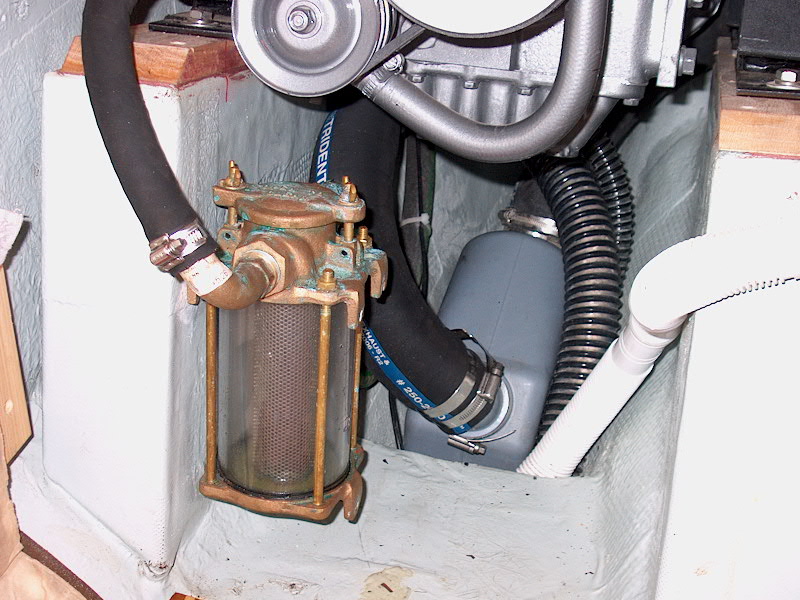
Ow, my eyes!
Those bilge pictures just scream of neglect and lack of proper installation. However, they could have been taken in any one of 200 boats...since most look just like that.
I'd trash that exhaust system and put in new components and a waterlift. There's nothing good about what I see in the pictures, and a jacketed system, particularly one that looks like that, has little to recommend it.
I think you'll need a new elbow/riser at the engine end, to start. This is generally considered a wear item to begin with, and will cost around $100 to buy and untold pain and suffering to replace, particularly if everything is nicely corroded together as shown in the photos. The new elbow also contains a nipple where the raw water injection occurs, just downstream of the high bend.
After a short length of 2" hose, you need a waterlift chamber somewhere downstream. Finding a suitable location for the waterlift is often one of the more challenging parts of installation, but there's room somewhere. Waterlifts can run around $70 for one of the lightweight
Vetus Waterlok models (like I have), or $150 or so for one of the
fiberglass versions. The glass ones are better if you have the room, but the Vetus plastic versions are handy in that they fit into tight areas, and have rotating cuffs for the inlet. The pitfall of a Vetus is that the plastic can melt if you run the exhaust without cooling water--an unlikely scenario if the cooling system is properly maintained, but a possible one nonetheless. It's not something that concerns me, personally.
Finally, you need a long length of hose, incorporating a high loop just before the transom outlet, and all the requisite clamps. With the removable sole, most of the exhaust replacement work could be much more straightforward on a Vega than it might be on most boats that lack the convenient access. You may need a larger transom outlet to accept 2" hose.
The stuffing box poses no major issues. You likely need new packing, which is inexpensive and can be replaced with the boat in the water. You might even find, in the short term, that you can crank down a bit on the packing nuts and slow the current rate of leakage, which is frighteningly high and is the sort of thing that far too many boat owners leave blithely unattended, counting on their bilge pump to keep up.
BAD idea.
Breaking free the packing nuts may be the worst part of this job. However, I wouldn't bother doing this without also replacing the stuffing box hose and clamps. All that rust and decay...this is not a place to hope for the best. Replacing the hose will require pulling the shaft, which will not be a fun chore (and I bet there's no
waterproof grease on
those components!) But repacking the stuffing box is even easier once the whole thing is disassembled. However, this is not strictly necessary, at least not until you need to replace that hose.
Now, whose money should cover this? Well, this completely depends on the asking price of the boat, and how the boat's condition was initially represented. In my opinion, one must expect a certain number of maintenance and upgrade-type findings on an older boat, particularly one at the lower end of the price scale. Therefore, a buyer must expect that the lower price, to some extent, is already accounting for the need for certain improvements.
If, however, the price point is at a higher level for the particular type of boat, and the boat was represented to be in overall good condition--and priced accordingly--then there is legitimate cause to renegotiate a purchase price based on unexpected findings. If you've yet to make an actual offer on the boat, then simply incorporate the maintenance items you've located into your offer price, to the extent you feel is fair; the seller can decide to accept or not, but you will have made an informed offer that represents what the boat is actually worth to you.
If you have made an offer, only to find certain findings unexpectedly after the fact, then in some cases renegotiation is the route of choice. I strongly recommend that, when renegotiation is necessary, you choose to renegotiate the price of the boat to a lower point that is acceptable; don't have the seller take care of the repairs, in other words. Just get the price lowered to a level that you feel more accurately represents the boat in her current condition, and the work you foresee being required. Seller-performed (or seller-hired) maintenance and repair work is, in most cases, less careful and will often be substandard in quality. So move forward based only on the bottom line, rather than any attempt to have the seller "fix" any items.
In this case, the repairs at hand look to be in the $500 range for materials, give or take, plus your own labor. Of course, said repairs could blossom into more, if you should (for example) find that the shaft is scored by the packing and requires replacement, or if you can't get the coupling off and require a replacement, or some such. But that's all part of the fun and frustration of buying any older boat. One cannot foresee all the pitfalls in the road ahead; all one can do is start from the most informed position possible.
Resist attempts to "nickel-dime" the seller on particular items. I favor an approach where you simply make an offer that reflects, for you, the bottom line price that you feel is fair, given all the information you have at hand. Negotiating particular items generally leads to unhappiness on both sides of the table, and rarely makes for a satisfactory experience.
If you're prepared to simply walk away from the boat should negotiations not go your way, then make your offer as low as you want. But if you truly would like to see this deal go through, then a reasonable--yet informed--approach to the repricing negotiations is called for. In the end, what's $500 or so (or even more) if you end up with a boat that truly fits your needs? Of course, some folks seem to be able to search perpetually for that "perfect" boat, never actually finding satisfaction. But if you think you've found the boat for you, and the asking price, at least to start, seems to be within a generally reasonable range given the condition of the boat, then I think it makes the most sense to work vigorously to see the deal through to fruition. This includes, of course, the need to offer a fair price from your perspective, and also to renegotiate afterwards if
unexpected findings crop up--but not for something that was known before the offer was made.