I'm depressed. I just hauled Fizz today. In the course of powerwashing the rather thick slime (but no hard growths) of Fizz's green bottom...
I saw a little white thing. Down there, about a foot up above the bottom of the keel. I picked on it, thinking it might be one of those weird one sided clams growing on the side of the keel. It burst and the smell of sytrene wafted up from the liquid that was on my fingers.
My mind went.... nooo... a ZIT. A boat ZIT. That white thing was in fact the bulging gelcoat. I promptly went around Fizz, trying to find any other zits... couldn't find any. There was only one as far I can tell. The bottom is pretty smooth so I am reasonably sure that the one I found was the only one though I probably will end up scraping the bottom to be 100% sure.
So... any advice on how to repair the lone, single boat zit?
If it helps, Fizz is a 1978 Sea Sprite 23. It is 28 years old now and this zit is the first I have found.
- Casey
Something Nasty Down There
-
Jason K
- Boat Obsession Medal Finalist
- Posts: 741
- Joined: Fri Mar 18, 2005 10:41 pm
- Boat Name: Rambunctious
- Boat Type: J/30
- Location: Mandeville, LA
- Contact:
Grind it out and let it fully drain. You should try and grind a symetrical and shallow depression. Wet out the repair area with unthickened epoxy. Follow that with epoxy thickened with silica. Fair and paint.
A lonely blister is not cause for significant concern. You do not need to barrier coat or take any other drastic steps.
I know zits are disturbing, but your boat is only 28 years old. This is part of the growing up process. :)
A lonely blister is not cause for significant concern. You do not need to barrier coat or take any other drastic steps.
I know zits are disturbing, but your boat is only 28 years old. This is part of the growing up process. :)
-
Tim

- Shipwright Extraordinaire
- Posts: 5708
- Joined: Tue Apr 01, 2003 6:39 pm
- Boat Name: Glissando
- Boat Type: Pearson Triton
- Location: Whitefield, ME
- Contact:
Don't fret. Open the area, rinse with plenty of fresh water, and let it drain/dry this winter. If you continue to see discharge (unlikely), perform occasional rinses with more fresh water. This will encourage the styrene to leach out.
In the spring, address it as Jason (#218) suggested. Don't worry about it.
In the spring, address it as Jason (#218) suggested. Don't worry about it.
---------------------------------------------------
Forum Founder--No Longer Participating
Forum Founder--No Longer Participating
Sigh...
You know sometimes you have a day that you find unpleasant things about your boat that you did not find before? Well, that day is mine.
The zit is not one. There are a number of them. I will have to remove the bottom paint competely to check the bottom more carefully.
One odd thing about the zits... They do not go thru the gelcoat to the laminations. In fact, I think Fizz actually has not one, but TWO gelcoat layers. I burst a few zits and scraped it with a knife and got smooth and hard gelcoat. No raw fiberglass at all.
Honestly, this does not make any sense to me because all cases of blisters (or zits or pox) always seem to talk about affecting the laminations, not the underlying gelcoat. So far, I have found absolutely no information similar to what I found online.
Right now, my theory is that Fizz got a second coat of gelcoat sometime in the past and the second coat is failing. Every single zit I burst always exposed more gelcoat, never any raw fiberglass.
Any advice on what to do next? I think stripping the bottom paint is the fist thing to do...
- Case
-
Tim
- Shipwright Extraordinaire
- Posts: 5708
- Joined: Tue Apr 01, 2003 6:39 pm
- Boat Name: Glissando
- Boat Type: Pearson Triton
- Location: Whitefield, ME
- Contact:
Maybe there is another layer of something over the original gelcoat that is allowing water beneath it. It could be some sort of barrier coat, or aftermarket treatment, or old paint, or even gelcoat. It is common to find water in this sort of material, which can often bulge it out and make it appear blister-like. Heavy layers of bottom paint often allow this too.
"Blisters" like these are a far cry in severity from the real hydraulic blisters caused by a chemical reaction between stryene binders and salt water. Yours may well dry up and disappear before too long, actually.
Without seeing them firsthand it's hard to say, and I don't want to be blithe, but it doesn't sound like the world is coming to an end either. Continue inspecting them as you have been, and it certainly wouldn't hurt to strip the bottom down as a safeguard and to better determine what's going on.
---------------------------------------------------
Forum Founder--No Longer Participating
Forum Founder--No Longer Participating
-
bcooke
- Master of the Arcane
- Posts: 2272
- Joined: Sat Oct 04, 2003 10:55 pm
- Boat Name: Jenny
- Boat Type: 1966 Pearson Triton
- Location: Rowley, MA
- Contact:
A couple of years ago I brought up the topic of blisters. At the time the best thing I heard was a question.
"How many boats have you heard of that sank from blisters?"
I don't think blisters are the big deal some people (barrier coat salespeople for starters) make them out to be.
I haven't been paying so much attention to the science of blisters since then but I think I remember that blisters can definitely occur in the gelcoat. It is when the blisters go deeper into the laminations that you have a 'problem' so to speak. Gelcoat is just pigmented resin as far as I know so it will be susceptible to blistering as much as the rest of the laminate. I am no expert though.
It is good that you worry about your boat but I think you can rest easy on this one. Nothing bad is going to happen and the fix is relatively easy.
-Britton
-
CharlieJ
- Wood Whisperer
- Posts: 649
- Joined: Fri Aug 19, 2005 7:42 pm
- Location: South coast of Texas, Matagorda Bay
Many boats with white hulls will have a second gelcoat over ( underneath) that that is a darker color. When doing the layup it is really difficult to spot air bubbles against white gel coat so many times they'll spray a darker layer then do the layup to make bubbles stand out.
That MAY be what you are seeing as that underlying harder layer.
That MAY be what you are seeing as that underlying harder layer.
I think you're right CharlieJ. The inner gelcoat isn't dark colored but a rather much more yellowish color than the outer coat of gelcoat.
Another member of this forum told me in a private message that the gelcoat at the bottom in many sailboats often are done in layers, not in one layer as I thought. This is what it looks like... looks like there's 2 layers and somehow water got its way in between the two gelcoat layers and is causing some of the blisters. Fizz has hit bottom in the past (not by me, by previous owners) but never actually broke thru the entire gelcoat coat. It actually looks like the gelcoat may be as much as 3/16" at the bottom edge of the keel. Maybe more.
For now, I am going to ignore the blisters and focus on covering Fizz for the winter and do some winterizing work for the outboard engine.
Thanks for your comments - Case
-
Duncan
- Candidate for Boat-Obsession Medal
- Posts: 388
- Joined: Fri Mar 03, 2006 7:28 am
- Boat Name: Coquine
- Boat Type: Cape Dory 27
- Location: Montréal
- Contact:
Good catch - here's what mine looked like when I found pinhole osmosis along the waterline:CharlieJ wrote:Many boats with white hulls will have a second gelcoat over ( underneath) that that is a darker color.
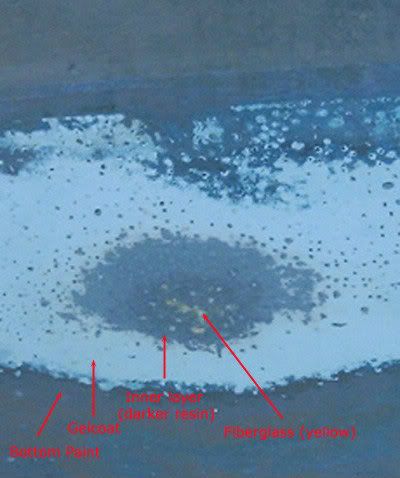
I was panicked at first, but it turned out to be pretty localized - a strip along the waterline, all dry and none of it went into the fiberglass.
I ground it down smooth and rolled epoxy on it. Faired, painted and no worries.

Cape Dory 10 & 27